
The Phrase Gets Used More Broadly Than It Should
Waterproof composite decking is one of those phrases that can sound clearer than it really is. Buyers often hear it and imagine a deck where water simply stops being a concern. In reality, water still matters enormously. It matters on the walking surface, in the gaps between boards, around the perimeter, and especially underneath where the structure must still drain and breathe properly.
That is why the smarter comparison is not just about the board. It is about the full water-management story. Composite Deck Pro's composite decking installation guide, maintenance-friendly decking article, Composite Deck Pro floor page, deck board width guide, and contact page are all useful because they push the discussion toward layout, substructure, and cleaning instead of relying on one high-comfort label.
Surface Water Resistance Is Not the Same as a Waterproof Deck Assembly
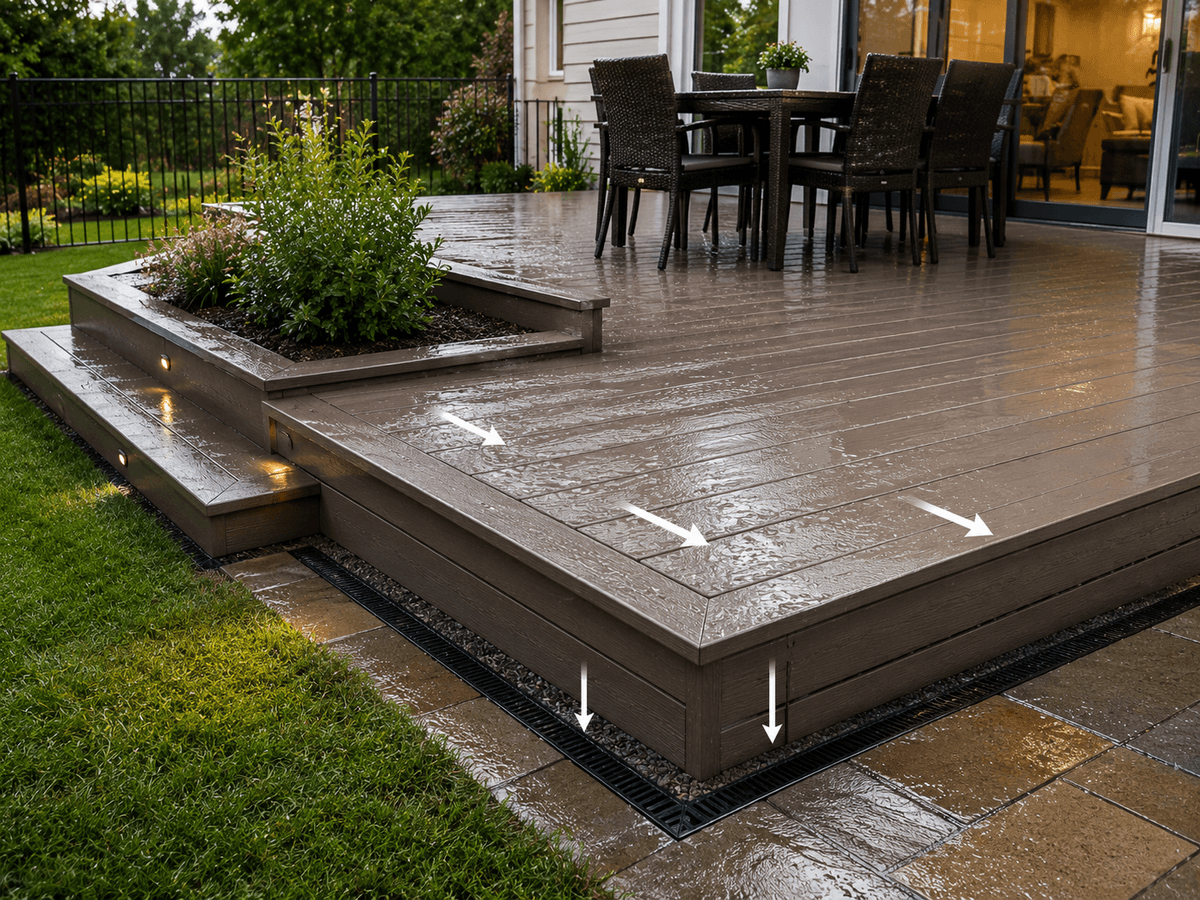
A board can resist moisture well and still be part of a poorly designed deck. That distinction matters. The walking surface might shed water reasonably, but if the framing below traps moisture, if debris blocks the drainage path, or if edge details are unresolved, the deck still has a water problem.
This is one reason homeowners should be careful with simplified language. A water-managing surface can be a very good thing, but it does not remove the need for sound deck construction and smart detailing.
- Ask where rainwater goes after it leaves the board surface.
- Check whether gaps and drainage paths stay open in real use.
- Treat the underside of the deck as part of the moisture plan.
- Remember that planters, leaves, and grime can still change water behavior.
- Do not assume moisture resistance removes the need for installation discipline.
Why Layout and Drainage Still Do the Heavy Lifting
Many water-related deck problems are actually design problems: low spots, blocked gaps, poor airflow, or detailing that lets dirt accumulate where it should not. That is why so many moisture issues become visible only after the deck is in service rather than during the material shopping stage.
This is where the quieter planning articles become useful. decking length guide, deck board width guide, wood versus composite decking article, non-wood decking alternatives article, and Composite Deck Pro homepage all support the same lesson: the deck has to be laid out as a system that expects water, not as a dry showroom display.
The Better Goal Is a Deck That Handles Water Gracefully
For most projects, that is the standard worth using. The deck does not need to defeat water. It needs to handle it gracefully. That means a surface that does not create unnecessary upkeep, a board arrangement that allows drainage, and a substructure that is not quietly being set up for trouble.
Once the expectation is put that way, buyers can compare products more intelligently. The material still matters, but it is only one part of the answer.
Most Moisture Trouble Starts Where People Do Not Look
Homeowners naturally focus on the top surface because that is what they see and touch. But many moisture issues begin below the walking surface or at overlooked transition points. Clogged gaps, trapped debris beside walls, poor airflow under low decks, and badly resolved edges can all turn a seemingly water-friendly material into part of a less durable assembly.
That is why waterproof language needs to be interpreted carefully. Moisture-conscious boards can absolutely help, especially when easier cleaning and lower absorption are important priorities. But those benefits only reach their full value when the deck underneath is also designed to move water away, stay ventilated, and avoid hidden pockets of damp buildup.
Buyers who understand this usually make better decisions because they stop searching for a board that magically ends the water discussion. Instead, they look for a deck system that remains orderly after rain, is easier to clean during wet seasons, and does not invite avoidable trouble below the surface. That is a far more useful goal and a much more durable standard for comparison.
Conclusion
Waterproof composite decking is best understood as a moisture-conscious category, not as a reason to stop thinking about water. The best decks still depend on drainage, airflow, and good layout. If those fundamentals are handled well, the material choice becomes much more meaningful and the deck becomes much easier to trust over time.